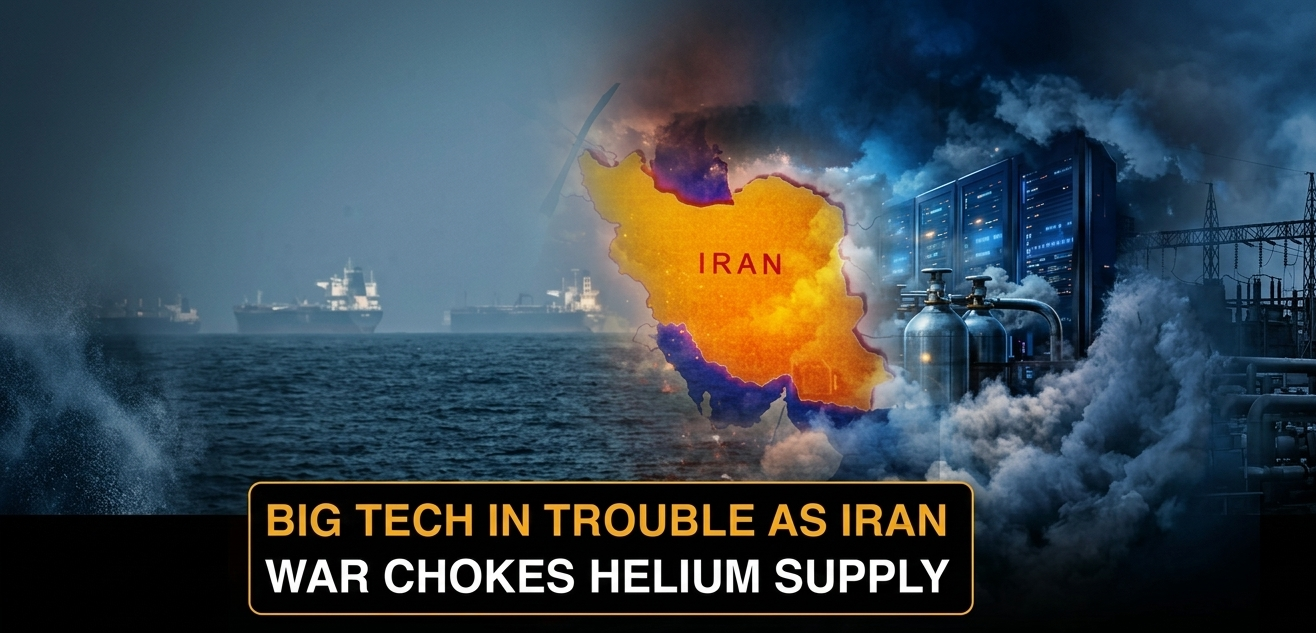
The war in Iran just knocked out one-third of the world's helium supply, and the tech industry is starting to feel it.
Helium is a critical input in semiconductor manufacturing. It's used to cool silicon wafers during fabrication and plays a key role in the etching process that forms transistor structures. There is no substitute. Researchers at the University of Birmingham have called this a "fundamental physical constraint."
How Iran's Strikes Disrupted Global Helium Production
Qatar produces roughly 30% of the world's helium as a byproduct of natural gas processing at its Ras Laffan facility, the largest LNG plant in the world. Iranian drone and missile strikes forced QatarEnergy to halt production on March 2 and declare force majeure. Subsequent strikes caused extensive damage that could take years to fully repair, and helium exports have been cut by 14%.
The effects are already rippling through global supply chains. Spot helium prices have surged 70 to 100% in a matter of weeks. South Korea, home to Samsung and SK Hynix, imports roughly 65% of its helium from Qatar and has flagged helium among 14 semiconductor materials vulnerable to the conflict. In the US, Airgas, one of the largest helium distributors, declared force majeure and cut customer shipments by half.
According to industry experts, only about half of Qatar's lost helium output can be replaced by alternative sources globally, including Russia's Amur 2 plant, German storage facilities, and US reserves. Most semiconductor manufacturers carry no more than two months of helium inventory.
Impact on Semiconductors, Electronics, and Beyond
The impact extends beyond chips. MRI machines depend on helium for cooling superconducting magnets. Rocket launches require helium for fuel tank purging. Aluminum prices have hit four-year highs as Gulf production faces broader disruption.
If this conflict continues, expect chip shortages to cascade into every product that relies on a circuit board: laptops, phones, cars, appliances, and the data centers powering the AI boom. The global semiconductor supply chain has a single-point-of-failure dependency on a region now at war, and there is no quick fix.